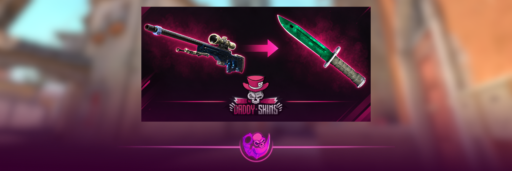
A CS2 skin upgrader lets you risk a lower-value skin for a chance to receive a more expensive one.
Instead of opening a case and getting a random item from a large pool, an upgrader lets you choose the skin you want to go for before you play. The bigger the jump between your starting value and the target skin, the lower your chance of successfully hitting the upgrade.
That makes upgrading easy to understand, but there is one thing you should know immediately:
An upgrade is never guaranteed.
If the upgrade succeeds, you receive the target skin. If it fails, you lose the value you put into the attempt.
On DaddySkins, you can use the DaddySkins Skin Upgrader to choose a target skin and see your chance before confirming the upgrade. DaddySkins also describes the Upgrade system as provably fair, meaning the result can be verified rather than being decided manually after you play.
What Is a CS2 Skin Upgrader?
A CS2 skin upgrader is a chance-based system where you use the value of a lower-priced skin or balance to attempt to win a more valuable CS2 skin.
The basic idea looks like this:
| Starting item | Target item | What changes? |
|---|---|---|
| Lower-value skin | Slightly more expensive skin | Higher chance |
| Lower-value skin | Much more expensive skin | Lower chance |
| Several times the starting value | Premium knife or gloves | Much lower chance |
The important difference from normal skin trading is that you are not simply exchanging one skin for another of equal value.
You are accepting a risk in exchange for the possibility of jumping to something worth considerably more.
That is also what separates a skin upgrader from the Steam Community Market or normal player-to-player trading.
If you are new to the skin economy itself, our CS2 Skin Trading for Beginners guide explains how float, demand, rarity and market pricing affect CS2 items.
How Does a CS2 Skin Upgrader Work?
The process is much simpler than it sounds.
First, you choose what you want to put into the upgrade. Then you choose the more valuable item you want to try to get.
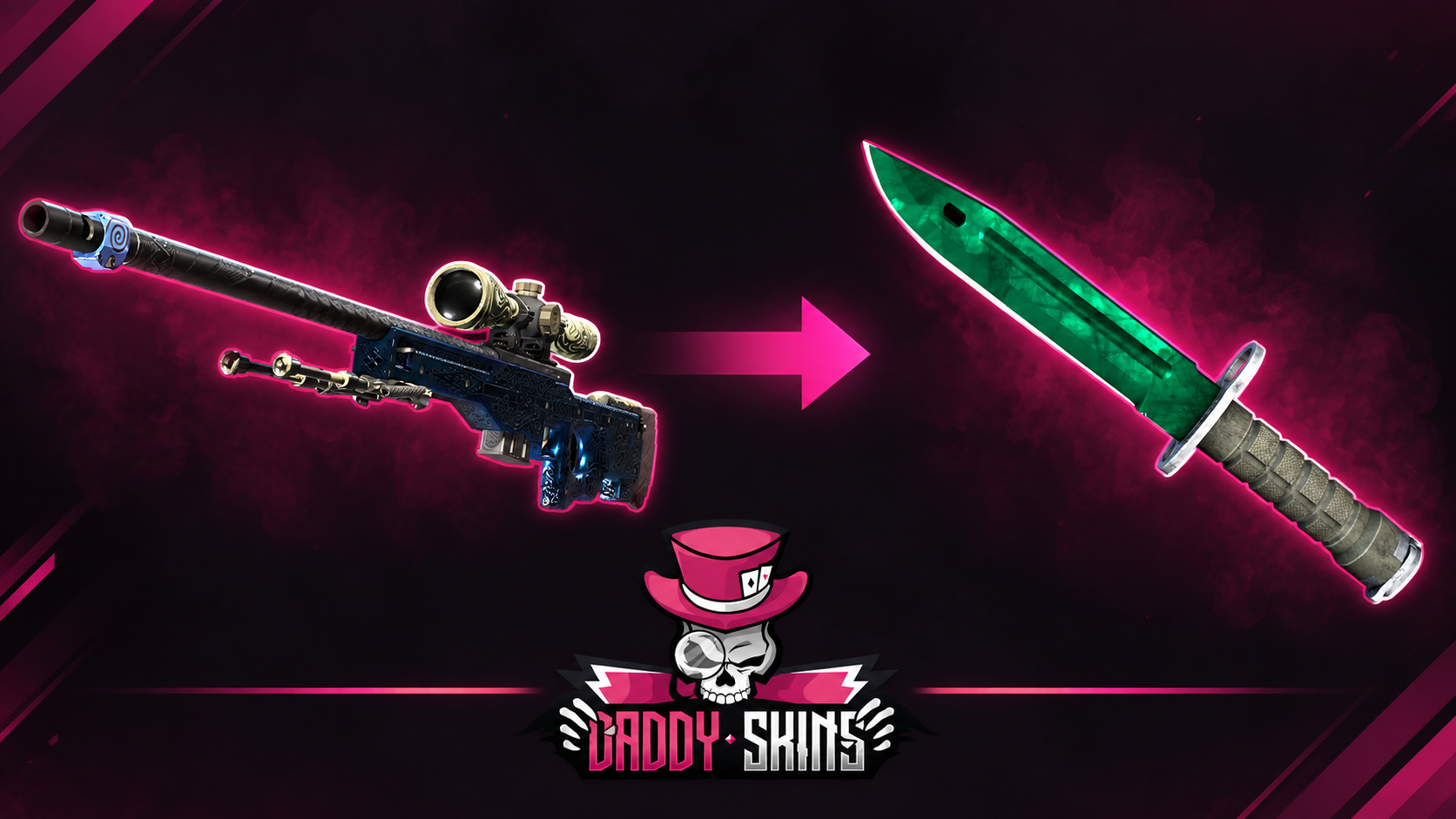
The upgrader shows your success percentage before you confirm.
For example, imagine you have a relatively cheap rifle skin but really want a better AK-47 skin.
Choosing a target only slightly more valuable than your starting item should give you a much better chance than trying to jump immediately from that same skin into an expensive Karambit.
That relationship is the most important thing to understand:
Higher target value = lower probability of success.
If you want to see the system directly instead of just reading about it, open the DaddySkins Upgrade feature and compare different target skins before actually confirming anything.
You can change the target and watch how the displayed chance changes.
How Do CS2 Upgrader Odds Work?
This is where people sometimes get confused.
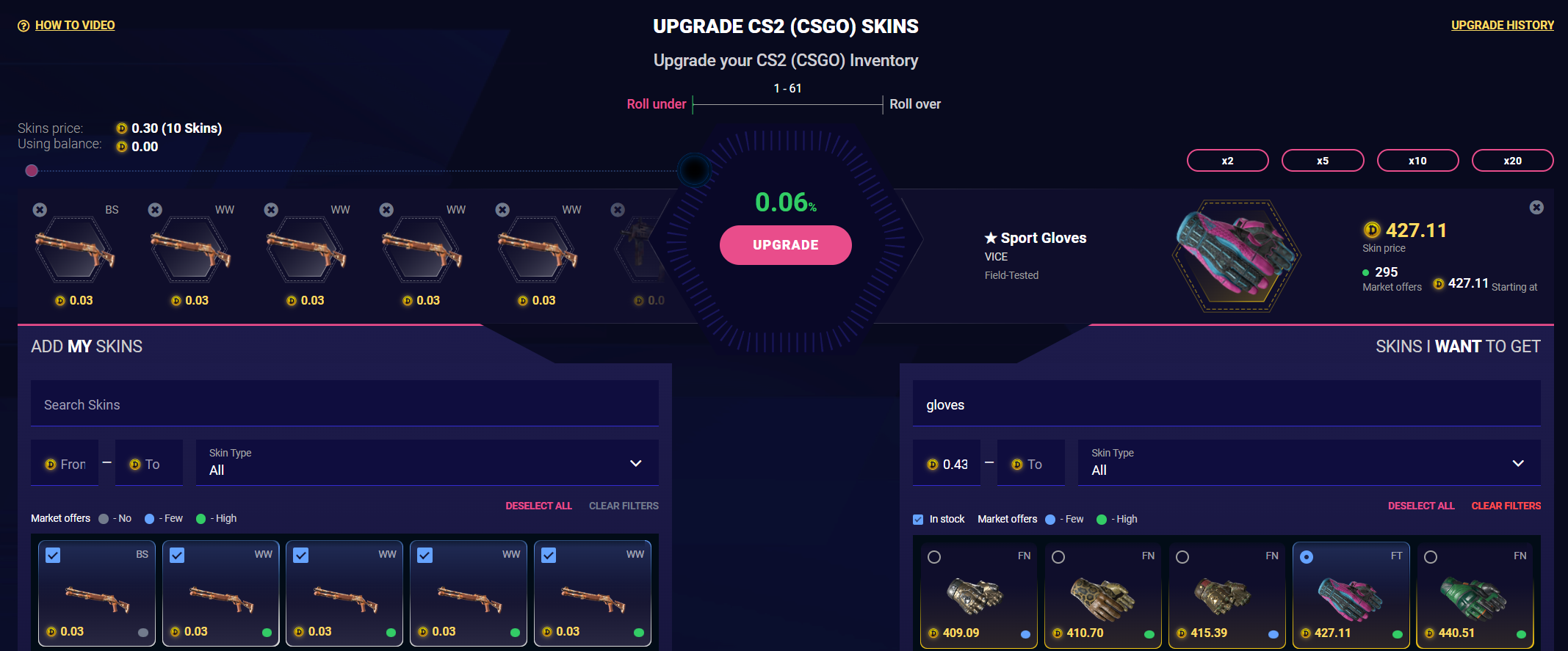
A 5x or 10x upgrade does not mean you have a good chance of multiplying your skin value five or ten times.
It means the reward you are targeting is significantly more valuable, which normally means your success percentage has to become significantly lower.
Think about an extremely simplified example.
If you put $10 of value toward a skin worth around $20, the theoretical value relationship is roughly 2x.
If you use that same $10 toward something worth $100, you are now trying to make roughly a 10x jump.
Those two upgrades cannot reasonably have the same probability.
Actual displayed percentages depend on the platform’s rules, item pricing and margin, so always use the live percentage shown on the upgrader rather than assuming the odds yourself.
On DaddySkins specifically, skin prices used for Upgrade are tied to market pricing, and its support documentation says Upgrade prices are refreshed regularly to stay aligned with the market.
What Does the Upgrade Multiplier Mean?
The multiplier is an easy way of understanding how large your attempted jump is.
A lower multiplier means you are targeting something closer to your starting value.
A higher multiplier means you are taking a much larger shot.
That creates a straightforward trade-off:
Smaller upgrade → better chance, smaller reward
Bigger upgrade → lower chance, bigger reward
This is why choosing the biggest knife available is not automatically the best move.
You might technically be able to target an expensive Butterfly Knife or Karambit, but if the displayed chance is extremely small, you need to understand what you are risking before confirming.
If a knife is your end goal, our CS2 Knife Tier List ranks the current knife models so you can decide which one you would actually want before targeting one.
How to Upgrade Skins on DaddySkins
DaddySkins has a dedicated Upgrade mode built specifically around this mechanic.
Go to the DaddySkins Skin Upgrader and choose the item or value you want to use.
Then select the skin you want to target.
Before confirming, pay attention to three things:
- Your starting value
- The value of the target skin
- The displayed success chance
Do not choose a skin just because it looks expensive.
Choose something you actually want, look at the percentage, and decide whether the risk makes sense to you before clicking.
DaddySkins’ own tutorial describes Upgrade as a way to take a calculated chance at higher-value skins through its provably fair system.
That can include working your way toward premium rifles, knives and gloves. DaddySkins’ existing trade-up content also points players toward Upgrade as another way of moving from lower-value items toward knives or gloves.
CS2 Skin Upgrader vs Trade Up Contract
These two terms sound similar, but they are not the same thing.
| Feature | CS2 Skin Upgrader | Valve Trade Up Contract |
|---|---|---|
| Where it happens | Third-party platform such as DaddySkins | Inside CS2 |
| Choose an exact target | Yes, depending on available items | No |
| Uses skin value | Yes | No |
| Uses rarity/collections | Not like Valve contracts | Yes |
| Result | Target skin or failed upgrade | Skin from eligible collection pool |
| Probability | Displayed before attempt | Calculated from contract inputs |
A Valve Trade Up Contract is an official CS2 crafting mechanic based on rarity, collections and input skins.
An upgrader is based primarily around the value you put in compared with the target you select.
If you specifically want to learn Valve’s system, read our CS2 Trade Up Contracts Full Guide.
We also have a separate step-by-step guide to using CS2 Trade Up Contracts.
Do not confuse the two systems when calculating risk.
CS2 Skin Upgrader vs Opening Cases
This is another important difference.
With a CS2 case, you normally open a predefined container and receive one of the items from its drop pool.
You do not pick the exact skin you are going to receive.
With a skin upgrader, you choose the target beforehand.
That is one of the main reasons people like the format.
If someone wants a specific knife rather than hoping that a random case eventually drops one, an upgrader gives them a direct target.
That does not mean it is safer or guaranteed.
It simply changes the type of risk.
| Case Opening | Skin Upgrader |
|---|---|
| Random item from a pool | Choose your target skin |
| Many potential outcomes | Success or failure |
| Case has its own odds | Upgrade displays a success chance |
| Cannot choose exact reward | Exact target is selected first |
If case opening is more your thing, see our updated Best CS2 Cases to Open in 2026 guide.
Can You Upgrade Cheap CS2 Skins Into a Knife?
Potentially, yes.
This is one of the biggest reasons people search for CS2 skin upgraders in the first place.
You may be able to use lower-value inventory toward a knife target, but the difference in value matters enormously.
Trying to turn a cheap skin directly into an expensive Karambit, Butterfly Knife or M9 Bayonet would require a much bigger value jump than targeting something closer to the starting amount.
That means the displayed success chance will reflect a much riskier attempt.
If your main goal is simply owning your first knife rather than chasing a massive upgrade, check our cheapest knives in CS2 guide first.
A cheaper target can make much more sense than automatically going for the flashiest knife on the site.
Does Float Matter When Upgrading CS2 Skins?
Float matters heavily to the market value and appearance of CS2 skins, although it is not what determines an upgrader in the same way it determines a Valve Trade Up Contract.
A Factory New skin with an unusually low float can be worth significantly more than another copy of the same skin.
Rare patterns, Doppler phases, Fade percentages and sticker crafts can also affect actual market demand.
That matters because you should understand the real item you are targeting rather than looking at the weapon name alone.
Before chasing an expensive skin, read our CS2 Float and Wear guide so you know why two versions of the same skin can have very different values.
Are CS2 Skin Upgraders Provably Fair?
A provably fair system is designed so that a game’s result can be independently verified using cryptographic data.
The important distinction is that provably fair does not mean guaranteed to win.
It means the random result can be checked to confirm that it was generated through the stated system rather than secretly changed after the outcome.
DaddySkins states that its Upgrade system uses a provably fair mechanism and says users can verify game outcomes through its fairness system.
That is still completely separate from your chance of winning.
A 10% chance remains a 10% chance even when the game itself is provably fair.
Is a CS2 Skin Upgrader Worth It?
It depends on what you mean by “worth it.”
If you are trying to build guaranteed long-term value, a chance-based upgrader should not be treated like an investment strategy.
Professional CS2 skin traders usually approach skins very differently. They study market pricing, supply, demand, float and liquidity rather than relying on random outcomes. You can read more about that in our How Professional CS2 Skin Traders Trade guide.
If, however, you have a smaller skin and want the entertainment of taking a shot at one specific item you really like, that is exactly what the upgrader is designed for.
Just remember the simple rule:
Never look at the prize without looking at the percentage beside it.
And do not increase your risk just because the previous attempt failed. Each outcome is its own event.
Common CS2 Upgrader Mistakes
The biggest mistake is targeting an item because of its price rather than because you actually want it.
Another is assuming a losing streak somehow makes the next upgrade more likely to succeed.
It does not.
A few other mistakes are worth avoiding:
- Ignoring the displayed percentage.
- Chasing a previous loss with a larger upgrade.
- Confusing DaddySkins Upgrade with Valve Trade Up Contracts.
- Not checking the target skin’s actual float, finish or market demand.
- Going straight for huge multipliers instead of deciding how much risk you actually want.
- Treating a chance-based game as guaranteed profit.
The easiest approach is to choose a fixed amount you are comfortable using before you start and stay inside it.