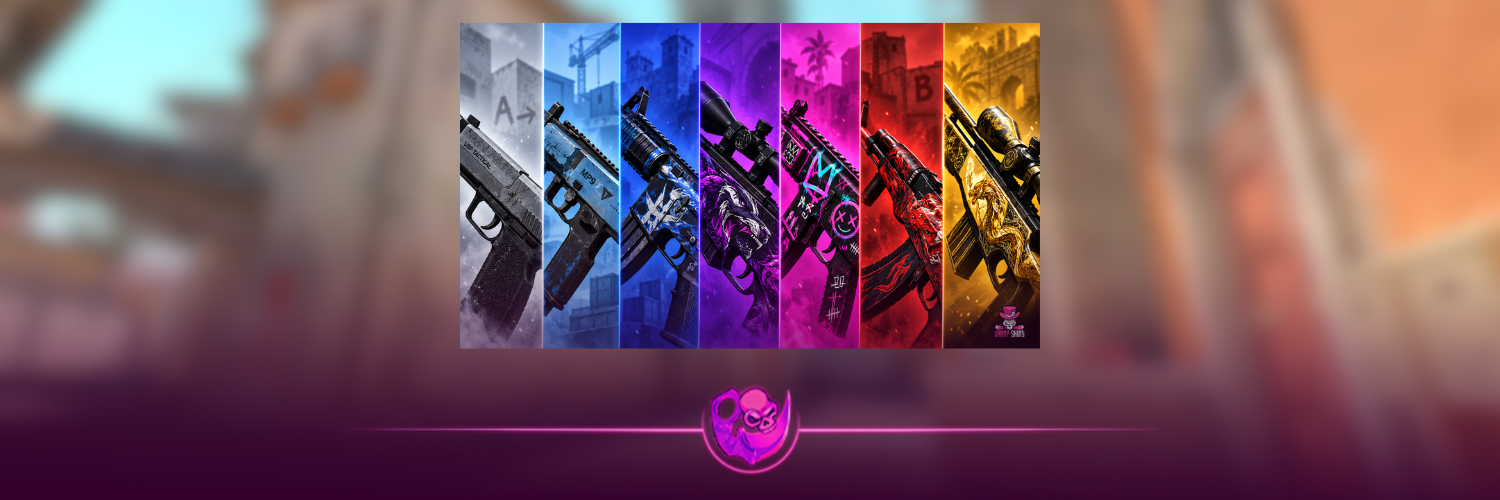
If you have ever opened a CS2 case and watched the colors fly past, you already know that blue, purple, pink and red mean something.
What gets confusing is what they actually mean.
A red skin is not necessarily a skin that looks red. A purple skin does not have to be purple. And a Factory New skin is not automatically rarer than a Battle-Scarred version.
Those colors represent the skin’s rarity tier.
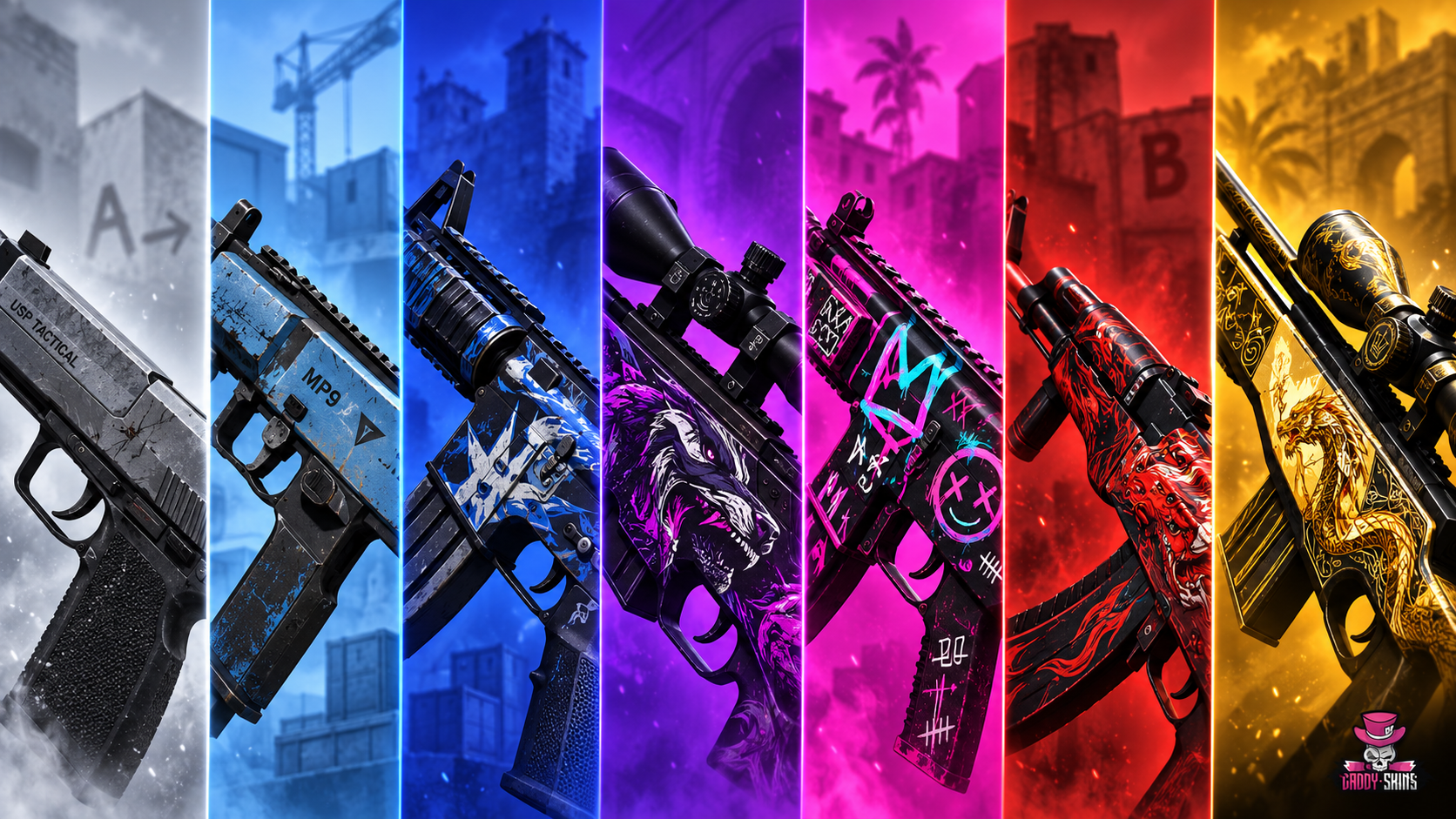
From lowest to highest, the normal CS2 weapon skin rarity order is:
Consumer Grade → Industrial Grade → Mil-Spec Grade → Restricted → Classified → Covert.
Knives and gloves appear as the separate gold Rare Special Item result in cases, while Contraband is a historical exception associated with the M4A4 Howl. Standard weapon cases generally start at Mil-Spec rather than Consumer or Industrial Grade.
CS2 Skin Rarity Order at a Glance
Here is the easiest way to remember every CS2 skin rarity.
| Order | CS2 Rarity | Color | Where You Usually See It |
|---|---|---|---|
| 1 | Consumer Grade | White / light gray | Collection and drop skins |
| 2 | Industrial Grade | Light blue | Collection and drop skins |
| 3 | Mil-Spec Grade | Blue | Most common standard case tier |
| 4 | Restricted | Purple | Mid-tier case skins |
| 5 | Classified | Pink | Higher-rarity case skins |
| 6 | Covert | Red | Highest normal weapon rarity in cases |
| Special | Rare Special Item | Gold | Knives and gloves |
| Historical | Contraband | Orange / gold | M4A4 Howl exception |
One thing is worth clearing up immediately: rarity color describes the item’s tier, not the colors painted on the weapon.
An all-white weapon can be Covert. A bright-red weapon could be Mil-Spec. When CS2 players call something a “pink” or a “red,” they are often talking about its rarity rather than its actual appearance.
That’s also why DaddySkins keeps color-themed guides separate from rarity guides. For example, our guides to cheap purple-colored CS2 skins and Restricted rarity skins answer two completely different questions.
Consumer Grade – White
Consumer Grade is the bottom of the normal weapon skin rarity ladder.
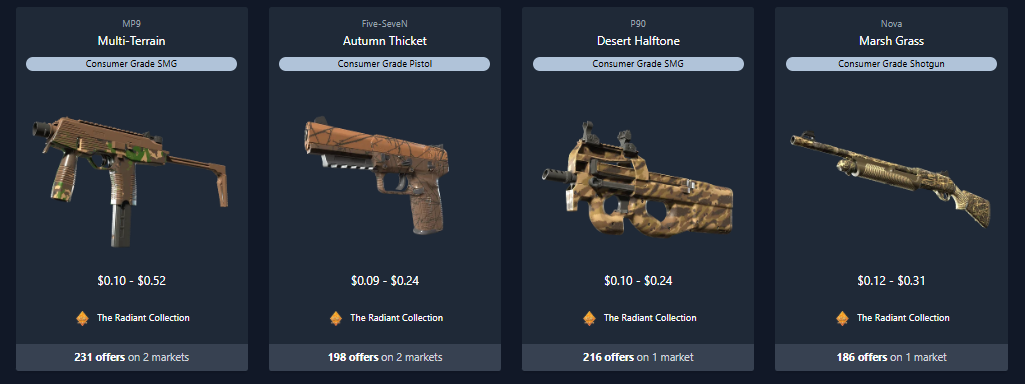
These are the white or light-gray items you will usually find in map collections and other collection-based drop pools rather than as the normal bottom tier of a keyed weapon case.
That does not automatically make them worthless.
The P250 | Sand Dune, for example, is Consumer Grade. More importantly, an old Consumer Grade skin from a scarce collection can sometimes be worth much more than a newer skin several tiers above it.
That is the first important lesson about CS2 rarity:
Higher rarity usually means lower supply, but rarity alone does not decide price.
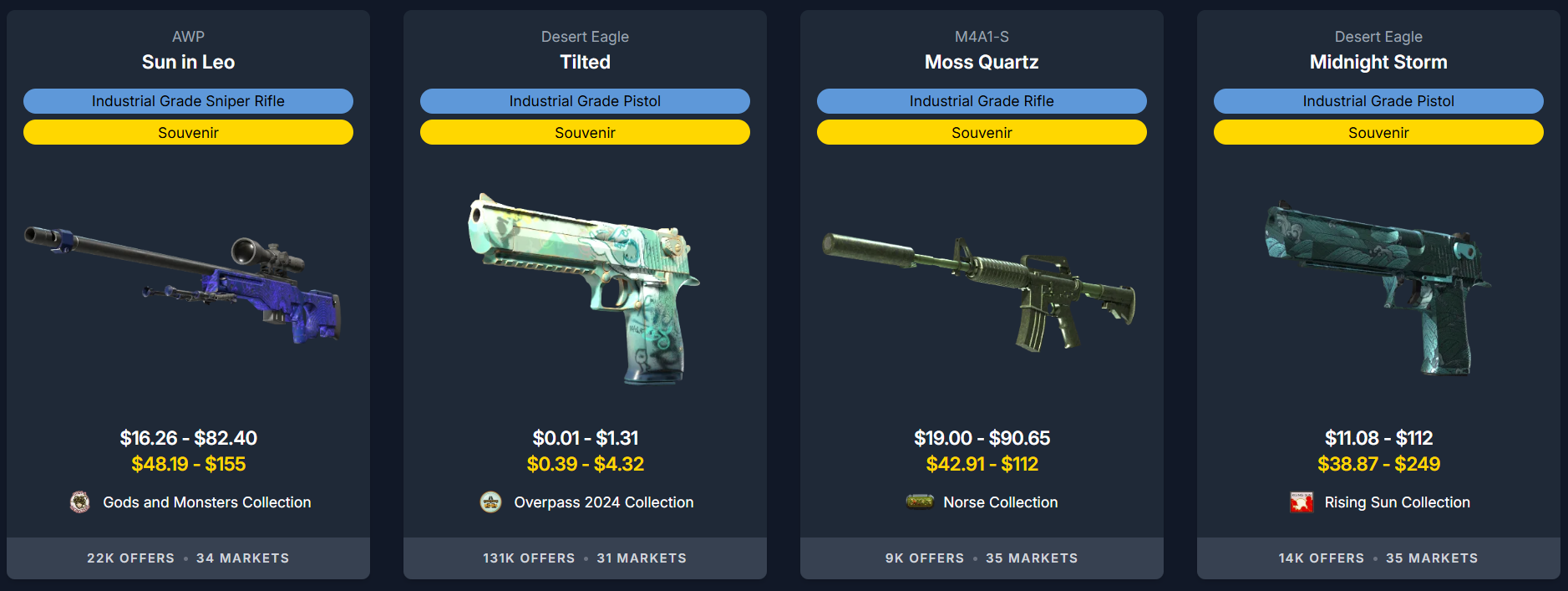
Industrial Grade – Light Blue
Industrial Grade is one step above Consumer Grade and is represented by light blue.
Like Consumer Grade skins, Industrial Grade items are primarily associated with collections rather than the normal four weapon tiers you see inside standard keyed cases.
They are still considered low-rarity skins, but the collection they belong to can matter enormously.
An Industrial Grade skin that has not entered the game in large numbers for years can become much more desirable than its rarity label would suggest.
This is why experienced traders normally check the collection first, rather than assuming every light-blue skin is cheap.
Mil-Spec Grade – Blue
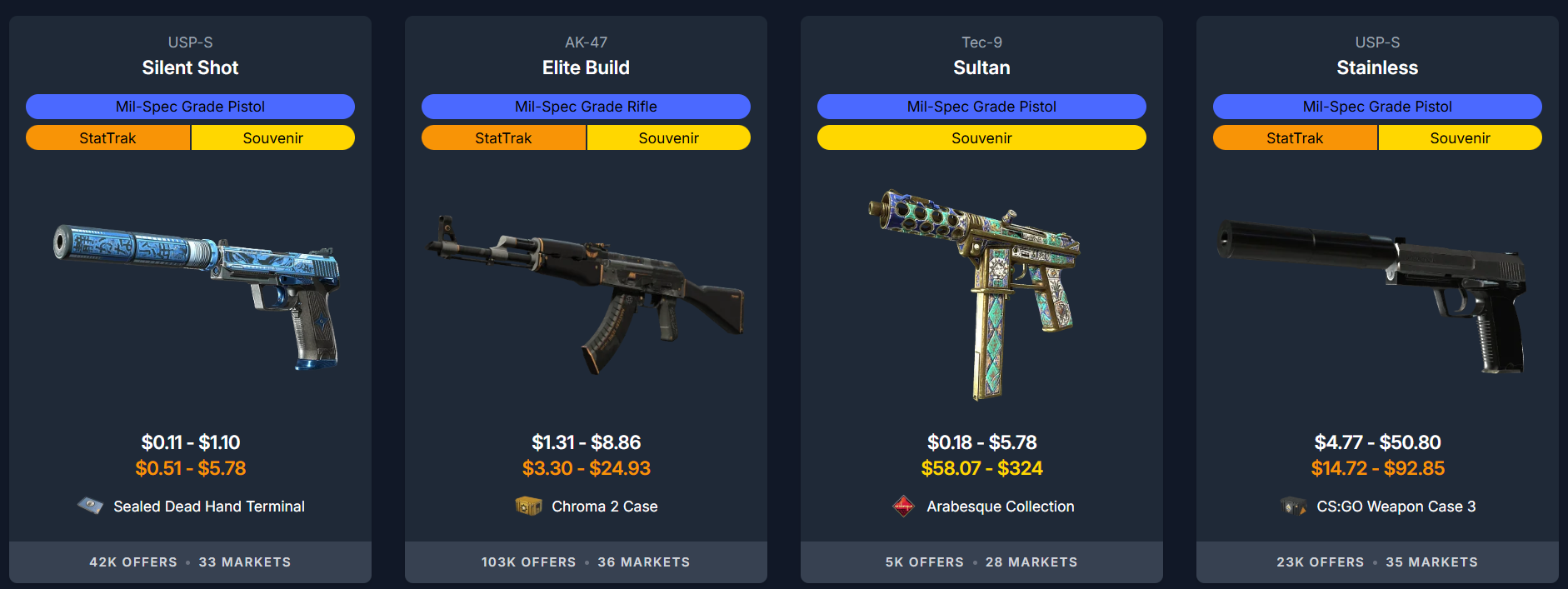
Mil-Spec is where the familiar case-opening rarity ladder really begins.
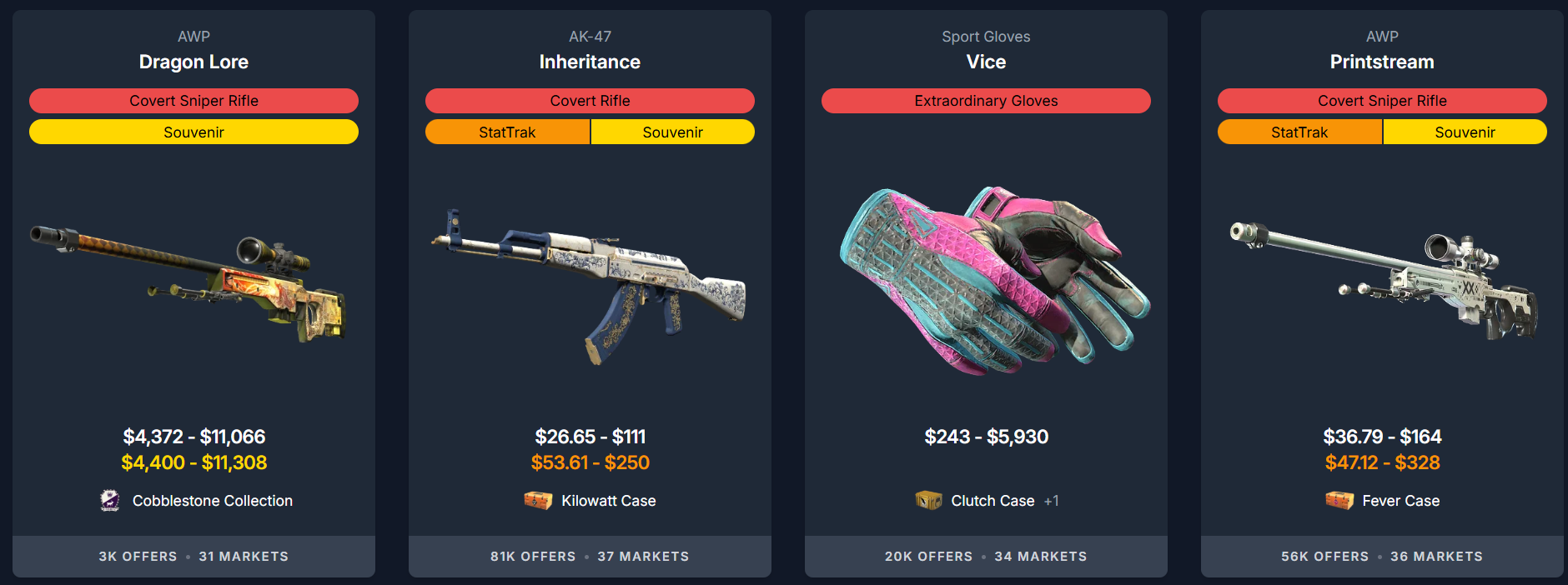
If you open a standard CS2 weapon case, blue is by far the color you are most likely to see. The disclosed odds for a Mil-Spec result are roughly 79.92%, which is why case openings seem to be filled with blue after blue after blue.
Mil-Spec skins are also the starting point for a lot of players learning Trade Up Contracts.
If you want inexpensive examples to experiment with, our cheapest Mil-Spec skins guide covers the budget end of this tier.
Restricted – Purple
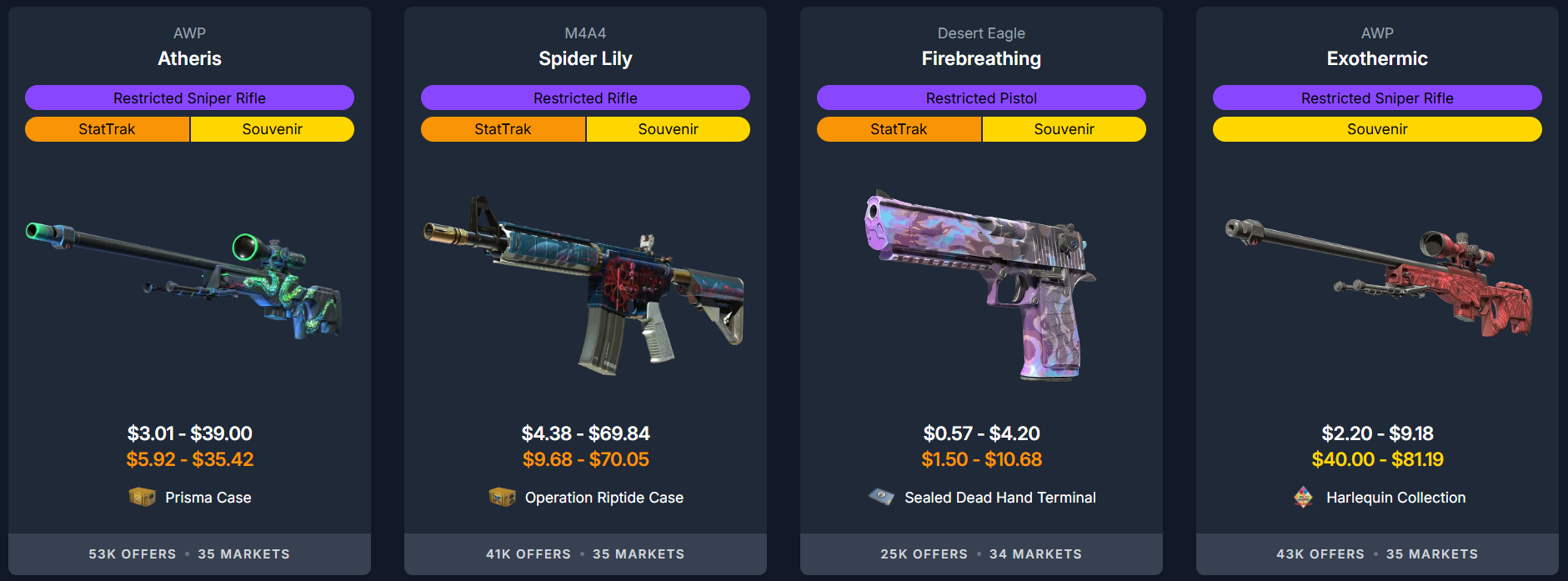
Restricted is the purple rarity tier.
This is where case openings start becoming noticeably less common. In a standard weapon case, the chance of landing the Restricted tier is roughly 15.98%.
Restricted is also an interesting price range because you can find skins that still cost very little despite sitting two tiers above Mil-Spec.
We recently went through that market in our Cheapest Restricted Skins in CS2 guide.
Again, purple rarity does not mean the skin itself will be purple. The rarity tag is purple; the artwork can be any color.
Classified – Pink
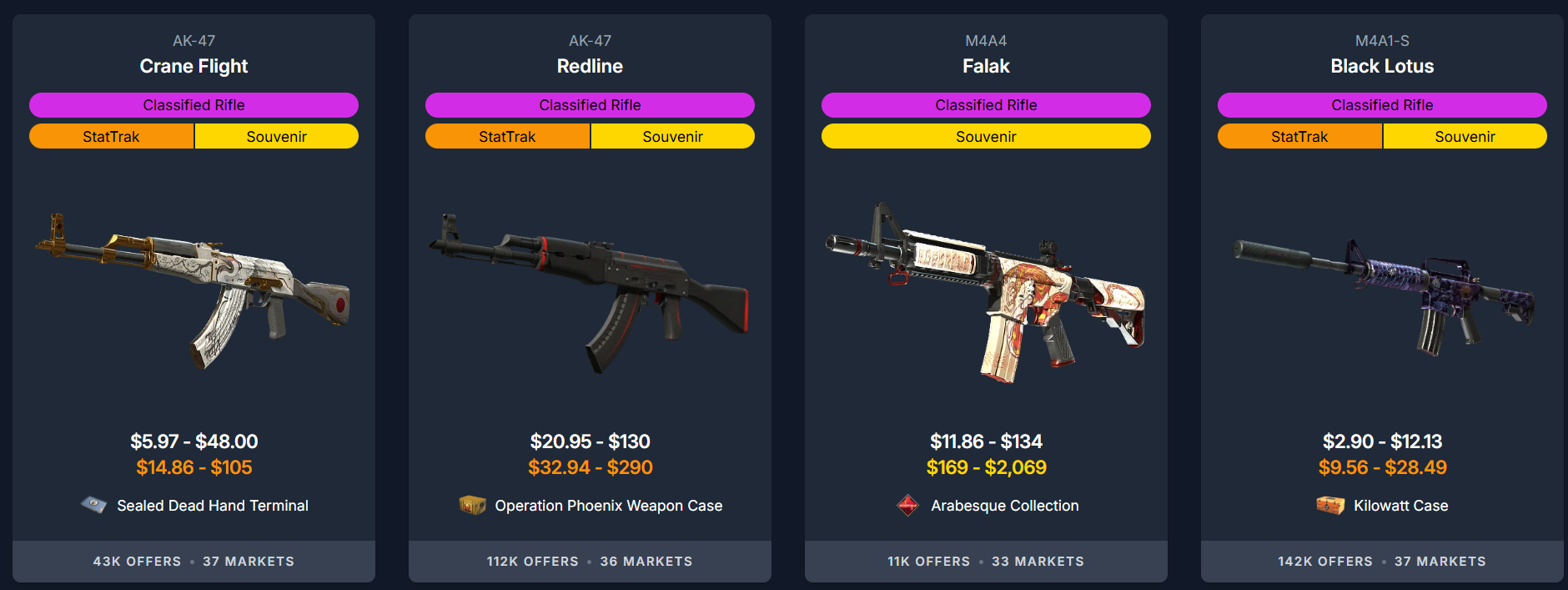
Classified skins use the pink or magenta rarity color and sit directly below Covert.
These are much harder to pull from a standard case, with disclosed odds of roughly 3.20% for the rarity tier.
This is also where the gap between rarity and price becomes really obvious.
A Classified skin can sometimes cost only a few dollars, while another Classified skin from a scarce collection can be worth dramatically more.
The AK-47 | Ice Coaled, for example, is Classified rarity despite its design being mostly blue and green.
If you are shopping this tier rather than trying to unbox one, we already ranked the cheapest Classified skins in CS2.
Covert – Red
Covert is the highest normal weapon-skin rarity in a standard CS2 case.
These are the famous reds.
A standard case has roughly a 0.64% chance of producing a Covert result, or around one red for every 156 openings over a very large sample. That obviously does not mean opening 156 cases guarantees one. Each opening is still its own independent roll.
Covert includes some of the most recognizable skins in Counter-Strike, but even within this tier prices can be wildly different.
Supply, weapon popularity, float, pattern, collection and demand all matter.
For players trying to enter the red tier without jumping straight into collector prices, see our updated Cheapest Covert Skins in CS2 guide.
What Are the Odds of Each CS2 Rarity?
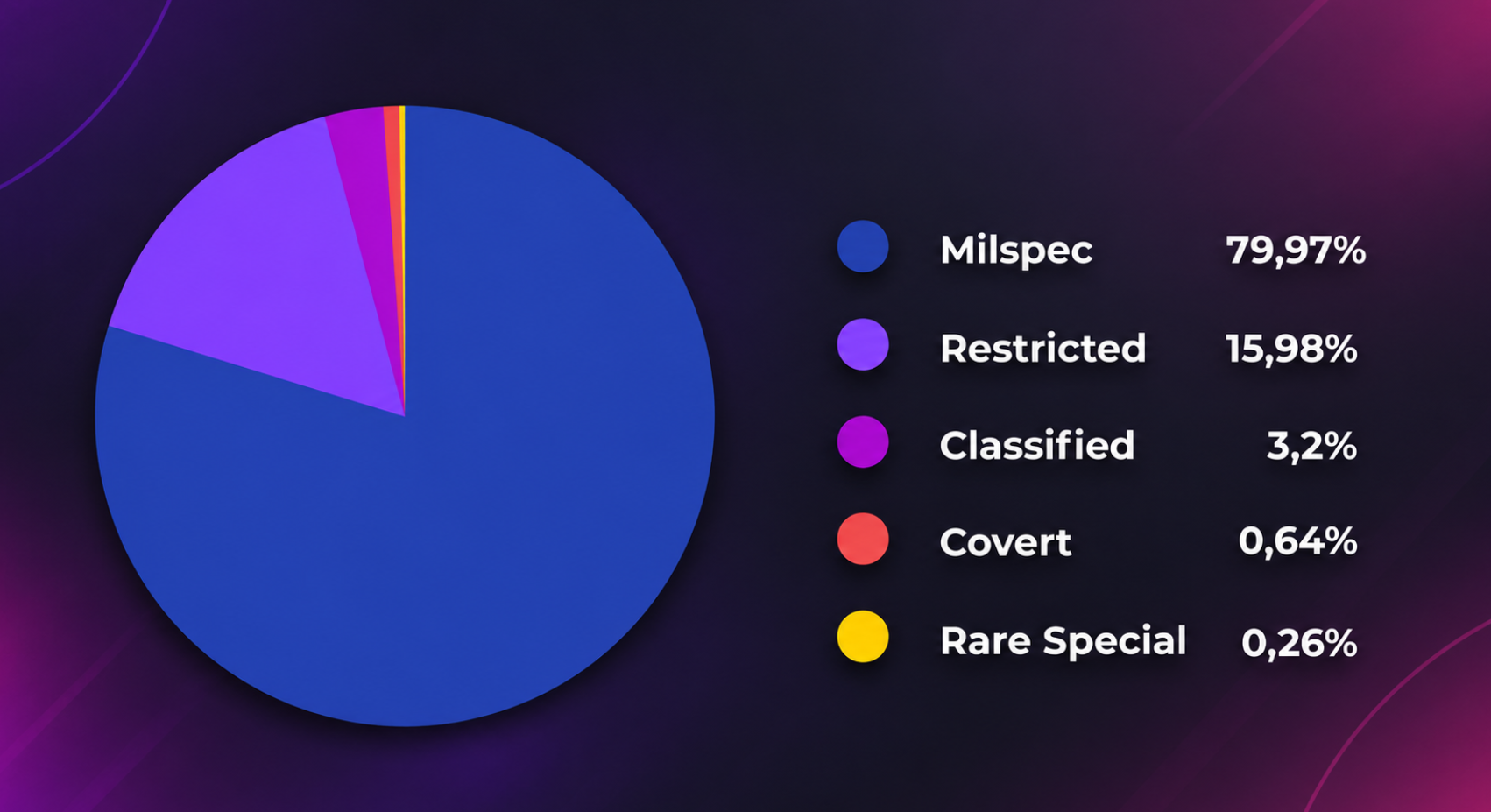
For a standard keyed CS2 weapon case, the commonly disclosed rarity probabilities are:
| Case Result | Color | Approx. Chance |
|---|---|---|
| Mil-Spec Grade | Blue | 79.92% |
| Restricted | Purple | 15.98% |
| Classified | Pink | 3.20% |
| Covert | Red | 0.64% |
| Rare Special Item | Gold | 0.26% |
That gold result works out to roughly one in 391 case openings over a sufficiently large sample.
Consumer and Industrial Grade are missing from this table for a reason. Standard keyed weapon cases normally begin at Mil-Spec. Other CS2 systems, collections and containers can use different rarity structures, so these percentages should not be treated as universal odds for every item source in the game.
If you are deciding which containers are actually worth looking at, our Best CS2 Cases to Open guide goes through the case side separately.
Where Do Gold Knives and Gloves Fit?
This is where a lot of rarity charts become misleading.
Gold is best thought of as the Rare Special Item result you can hit in eligible cases, rather than simply calling it the next normal weapon rarity after Covert.
Knives and gloves are presented separately from the normal gun-skin ladder, and the chance of rolling that special result in a standard case is roughly 0.26%.
Even then, “gold” does not tell you what the item is worth.
Two gold items can have completely different prices because the exact knife or glove model, finish, float and pattern can change the value dramatically.
A gold result tells you how special the result category is. It does not tell you what somebody will pay for the exact item you received.
What Is Contraband Rarity in CS2?
Contraband is the strange one.
It is not a normal tier that you can work your way toward by opening cases.
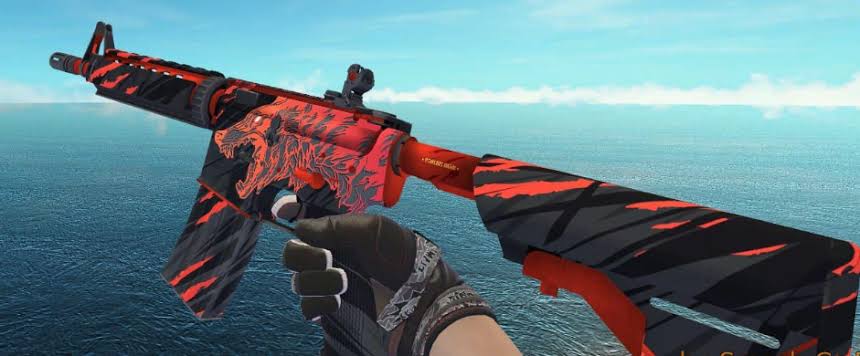
The M4A4 | Howl became the famous Contraband item after the original artwork was involved in a copyright dispute and the item was removed from its normal creation path. This left it with a unique historical designation and a permanently limited supply.
That is why putting Contraband directly above gold on a normal “drop chance” chart can be confusing.
You cannot simply open a case and roll a Contraband result.
If you want the complete story behind it, we have a dedicated M4A4 Howl rarity and history guide.
Does a Higher Rarity Mean a More Expensive Skin?
Not necessarily.
Rarity is one piece of the price.
The market is full of situations where a lower-rarity skin costs more than a higher-rarity one because fewer copies exist or players simply want it more.
The final value of an individual CS2 skin can also change because of float, exterior, pattern, StatTrak status, stickers, the collection it came from and current market demand.
Float is especially easy to confuse with rarity.
A skin’s rarity does not change. A Covert remains Covert whether it is Factory New or Battle-Scarred.
The float determines the individual item’s wear. If you want the full explanation of how that works, read our CS2 Float and Wear guide.
That distinction matters:
Rarity tells you the item’s tier. Float tells you the condition of that specific copy. Price is the market deciding how much all of those factors are worth together.
How CS2 Trade Ups Move Through the Rarity Tiers
The rarity ladder is also the backbone of Trade Up Contracts.
For the standard system, ten eligible weapon skins of the same rarity are exchanged for one skin from the next rarity level.
The normal path is:
Consumer → Industrial → Mil-Spec → Restricted → Classified → Covert
But there is now an important exception at the very top.
Valve changed Trade Up Contracts in October 2025 so five regular Covert skins can be exchanged for a regular knife or gloves from an eligible represented collection, while five StatTrak Covert items can produce a StatTrak knife.
That makes older rarity guides saying “Trade Ups stop at Covert” outdated.
If you are actually planning a contract rather than just learning the rarity system, use our full CS2 Trade Up Contracts guide before buying inputs.
This is also one of the strongest reasons to keep this article updated. The rarity colors themselves rarely change, but Valve can change what players are allowed to do with those rarities.
CS2 Rarity vs Wear, StatTrak and Souvenir
These terms are related to skins, but they are not the same thing.
| Term | What It Means |
|---|---|
| Rarity | Consumer, Industrial, Mil-Spec, Restricted, Classified or Covert |
| Exterior / Wear | Factory New, Minimal Wear, Field-Tested, Well-Worn or Battle-Scarred |
| Float | The numerical wear value of that individual skin |
| StatTrak | A variant with a kill counter |
| Souvenir | A special tournament-related item variant |
| Pattern | The way a finish is positioned or generated on that specific skin |
| Market price | What buyers are currently willing to pay |
None of those automatically changes a weapon from one base rarity tier to another. A StatTrak Classified skin is still Classified. A Battle-Scarred Covert is still Covert.
That sounds obvious once you know it, but it is one of the biggest sources of confusion for players getting into CS2 skins.
What Is the Rarest Color in CS2?
If you mean a normal standard case result, gold is the rarest color to hit, at roughly 0.26%.
If you mean normal weapon skins specifically, Covert red is the highest standard weapon rarity.
And if you are asking about Contraband, that is a separate historical designation rather than a regular rarity you can currently unbox.
Those three answers sound similar, but they describe different parts of CS2’s item system.